
Cu2O, Dicopper Oxide, Copper(I)Oxide, Copper Hemioxide, C.I. 77402, CAS 1317-39-1, EINECS 215-270-7
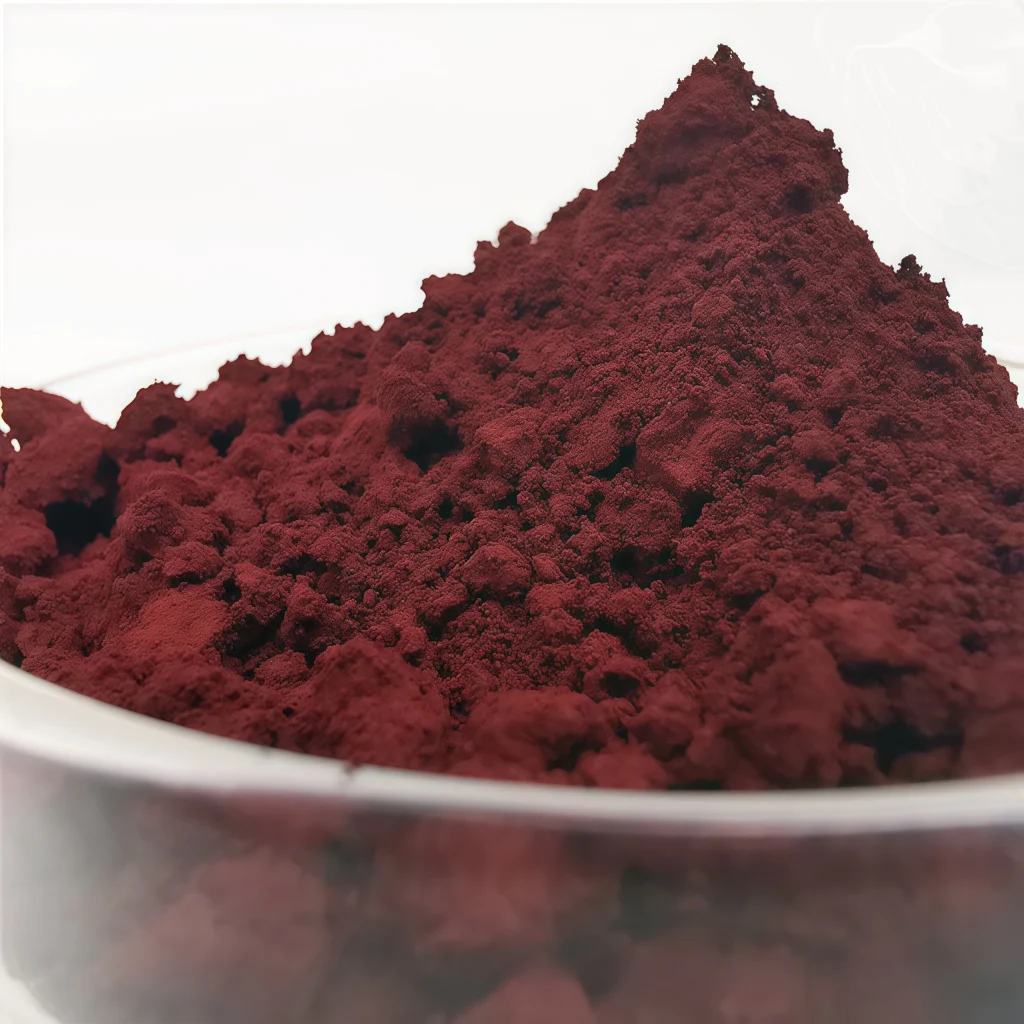
Product name: Cuprous Oxide.
Molecular formula: Cu2O.
Molecular weight: 143.09.
CAS number: 1317-39-1.
EINECS number: 215-270-7.
Appearance: A bright red powdery solid.
Purity: 99.9%.
Particle size: millimeter level,micrometer level, nanometer level.
Characteristics: High purity, small particle size, uniform distribution, large specific surface area, high surface activity, low loose packing density. Cuprous oxide is a monovalent copper oxide that is almost insoluble in water. It dismutates into divalent copper and elemental copper in acidic solutions, and gradually oxidizes into black copper oxide in humid air.
Application:
1.As an important inorganic material, it has a wide range of applications in catalysis, superconductivity, ceramics and other fields.
2.Used as catalyst, catalyst carrier, electrode active material, organic synthesis.
3.Used as a coloring agent for glass ceramics, optical glass polishing agent, red glass coloring agent, flame retardant and smoke suppressant for PVC, catalyst for organic synthesis, desulfurizer for oils, and hydrogenation agent.
4.Manufacturing artificial gemstones and other copper oxides.
5.Used for artificial silk manufacturing, gas analysis, determination of organic compounds, etc.
6.Used for manufacturing ship bottom anti fouling paint (killing low-level marine animals), insecticides, various copper salts, analytical reagents, red glass, copper plating and copper alloy solution preparation, electrical industry, etc.
7.Used for rectification electroplating, protective fungicides, crop fungicides, rectifier materials, etc.
8.Adding cuprous oxide powder to chemical fibers endows them with antibacterial and anti mold properties, thereby enabling textiles made from fibers containing nano cuprous oxide powder to possess antibacterial and anti mold capabilities.
9.Copper oxide powder can efficiently degrade organic matter as a photocatalyst under visible light, and is used for treating organic pollution in water.
10.In the building materials industry, it is mainly used for colored cement, colored cement tiles, colored cement tiles, imitation glazed tiles, concrete tiles, colored mortar, colored asphalt, terrazzo, mosaic tiles, artificial marble, and wall painting.
11.Used for boards, fertilizers, paper, pesticides, paints, sprays, rubber products, plastic products, etc.